
Fundraising Dispatch + Lendable: Grants 101
Interested in finding grants to support your work and add to your impact?
You’re in the right place.
There are 100’s of grants programs available for impact-focused organizations in Africa! Fundraising Dispatch curates opportunities and sends them direct to your inbox every week (here). We also provide guides and resources dedicated to growing your business, training your team, and making fundraising easier (here).
Grants open now!
Here’s a list of a sample of curated opportunities for you.
Under $100k
Awesome Foundation $1k.
Startupbootcamp Accelerator $25k.
2026 Startup Innovation Challenge. €50k.
Climate Intervention Environmental Impact Fund Grant. $75k.
Over $100k
DeveloPPP Ideas Ventures €100k.
UNICEF Venture Fund $100k.
DeveloPPP Classic Ventures €2m.
Livelihood Impact Fund $250k.
DRK Foundation $300k.
Seeding The Future $250k.
COMESA EAC Horticulture Accelerator (CEHA) $100k.
See short summaries below! Highlighting each opportunity’s:
Funding Goals, Grant Type, Geography, Sector, Eligibility, Deadline, etc
Hundreds more on our weekly newsletter & list of rolling opportunities
Grants and Grant Writing 101:
As part of Lendable’s programming and partnership with Fundraising Dispatch, you’ll have access to this high-level guide on raising grants for impact in Africa.
Here’s what you’ll find here:
Is your work eligible for impact grants?
What you need to know about grants
What you (most likely) won’t get grant funding for
What you need before you start applying
Is the juice worth the squeeze?
Where and how to start looking for grants
How to (quickly) assess your availability for any RFP or grant program
Tips: Writing a winning application
Tips: Catering your application to what the funder wants to hear
Other resources for fundraising
Summaries of the grants mentioned above (that you can apply for today!)
How to leverage Fundraising Dispatch and/or Grant & Co
Make sure you’re on the list to get new grants in your inbox every week and other powerful resources like this one.
Is your work eligible for grants?
It starts with your business and your business model
You do something that Western Governments consider to be a public good
Low income healthcare, micro/SME loans, humanitarian aid, renewable energy, job creation, environmental conservation, sustainable agriculture, transition lab research to the field, ambulance/fire response, potable water, etc
Your leadership identifies as (and/or your work predominantly impacts) members of historically marginalized groups
The public good must be more cost-effective than “state-of-the-art”
And if you have an “innovation” (technical or not).... does that lead to a public benefit?
i.e. Social Impact
What you need to know about grants
Non-dilutive capital
Usually project-based and restricted
Time-bound and mapped to specific activities, outputs, or outcomes
Some opportunities are very specific about what they will and wont fund
Not quick cash or an instant lifeline
General rule of thumb is that you need at least a year of runway
A “good” time line you can expect
Writing the application
4-6 weeks
Hearing back from the grantor after submitting
3-6 months
Due Diligence
3-6 months
Legal/Signing
3-6 months
Cash in the bank
3-6 months
We are over the moon ecstatic if there’s cash in the bank 6 months after submitting. It usually takes a year. Sometimes more.
What you (most likely) won’t get grant funding for
“Business as usual“
You need grant funding because you have a project you want to carry out that will further social impact
Said project is not under your standard operational model because it would sacrifice profit
Additionality: Grantors will ask: “Does this company need our charitable dollars to do this project, or would it happen commercially anyway?”
Things that have residual value or easy to steal
Cars, construction (very easy to steal bags of cement, timber, etc), computers, land, large processing equipment
Overhead (Salaries), CapEx, etc
One-Off Projects
Even R&D and Pilots have to link to the long term - systemic change
Is your business scalable? Is your work catalytic i.e. can your project be replicated in other settings?
Anything related to gambling, tobacco, or alcohol
Complexity: the harder it is to tell your story, the harder it will be to get grant funding
If your business relies exclusively on grant funding (that’s why NGOs exist)
Your best funder will always be your customer
What you need before you start applying
Data Room
Standard investment readiness documents
Company Registration Information
Business Plan
Audited Financial Accounts
Budget & Financial Model
Pitch Deck
Some kind of social impact assessment
Advanced investment readiness documents
Feedback from customers, previous funders, etc
Capitalization Table, Shareholder agreement
Org Chart, Board of directors/advisors
LinkedIn CV’s
Grant funding expanded documentation
Articles supporting your work / theory of change
Project Quotes
Photos and Videos / Testimonials
Relevant Licenses
Thought pieces you / your org has written
Employee manual, company policies
And more. Here’s a list of 50+ documents organizations should have when they fundraise: organized by priority (must haves, nice to haves, on the radar)
The last thing you want (speaking from experience) is to submit an application, not hear anything for 3 months, and get an email from the grantor saying:
We love the work you do and want to invite you to the second round of the funding application. You have 7 days to give us these 11 documents.
Make sure your Equipment Management Policy is notarized.
What a grantor may require when you win
Matching funding
Consortiums
NGOs, Academia, Governments, etc
Strict compliance
Vendors, proof of origin, invoicing, etc
Mile-stone based funding
Paid out in tranches
Third-party audits/evaluations
Public sharing of learnings
Or even the direct IP developed as a result of funding
What a grantor will ask you for when you win
Proof that the money will only be used for the approved purposes
Regular progress reports/calls
Often in their strict format
Financials/record keeping
They may even want a separate bank account for grant project activities
Evidence of impact
Managing a grant can be a full time job in of itself
Founders should be focusing on day-to-day organic growth of their business
Not cumbersome reporting to make a funder happy
That’s why groups like Grant & Co exist

Want some support in writing your grant applications?
If you’re generating $100k+ in ARR and have the budget to treat grants like a marketing expense in your business (i.e. pre-payment + success fee)…
So is the juice worth the squeeze?
Grants aren’t a “crapshoot”. The wrong Grants for you are.
Just like advertising isn’t a “crapshoot”. The wrong advertising for your business is.
If you find yourself retrofitting your mission to meet the requirements of a grant...
... it’s likely not the right fit for you.
But Grants also aren’t free money.
Just like Sales at your company don’t come free either.
The truth is more subtle.
There are many dimensions of whether a grant is worthwhile.
Does your company fit the RFP? Sector? Company Size? Registration Requirements?
Does your company fit with the funder? Does your company fit with the funder’s funder? Does your project fit the (often unwritten) goals of the funder?
What are the chances of winning? Is the prize worth the effort? Are there legal fees?
Once you win, will there be so much bureaucracy and reporting requirements that, at the end of the day, you wish you had never applied and accepted in the first place?
Whether to apply for a grant seems like more art than science.
See our full article here:

Fundraising Dispatch gives you the resources you need to make it worth it.
Where and how to start looking for grants
1. Your network
Who do you know that has raised grant funding? (Preferably in your geography/sector). Ask them:
How did you get it?
Would you be open to connecting me with your contacts?
2. Local Governments / Organizations / Embassies
Leverage groups that understand your local context
3. FundraisingDispatch.com
Get newly published RFPs and grant opportunities direct to your inbox. Leverage curated lists of rolling/recurring opportunities.
Don’t spend your time:
Endlessly scanning platforms where the majority of grants listed are for organizations (usually nonprofits) in the USA, UK, and Europe
Following 50+ LinkedIn accounts
Registering for databases that almost exclusively highlight fellowships, trophies, pitch competitions, and promises to win cloud credits (i.e. ignore programs with no direct monetary or educational value)
See a curated sample of grants below
And subscribe to premium to get access to our database:
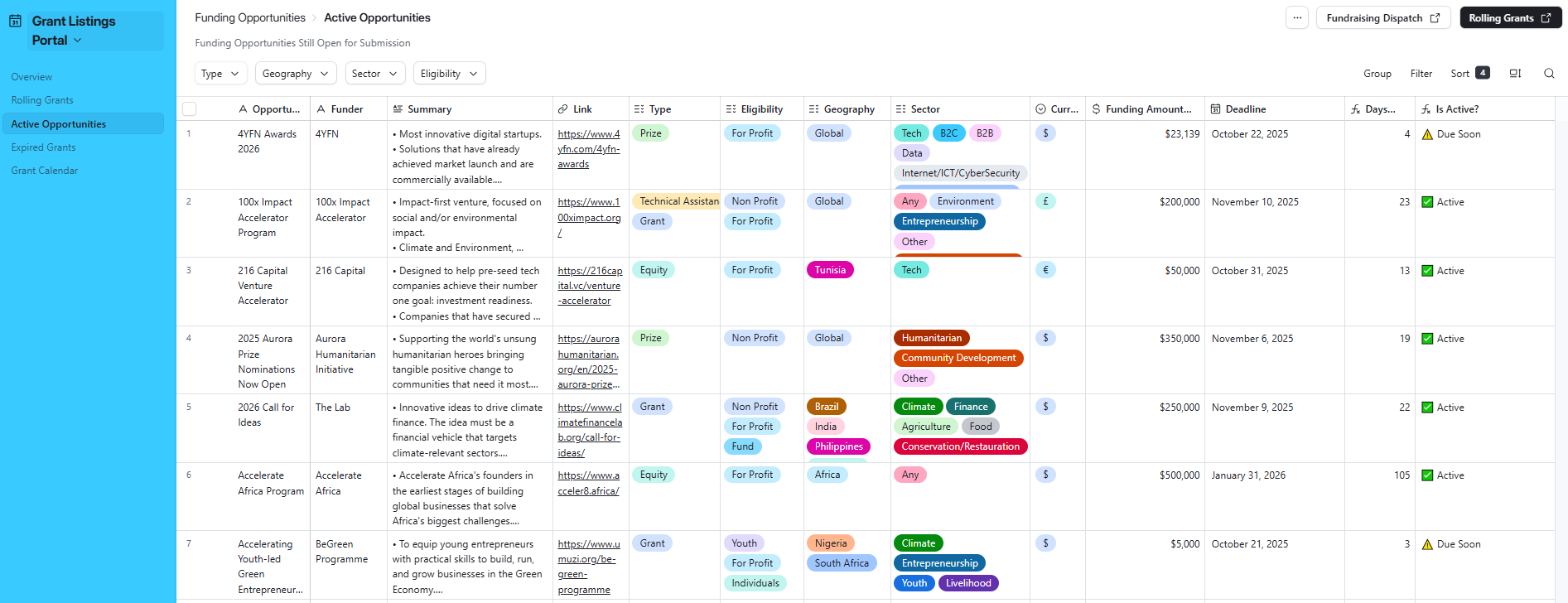
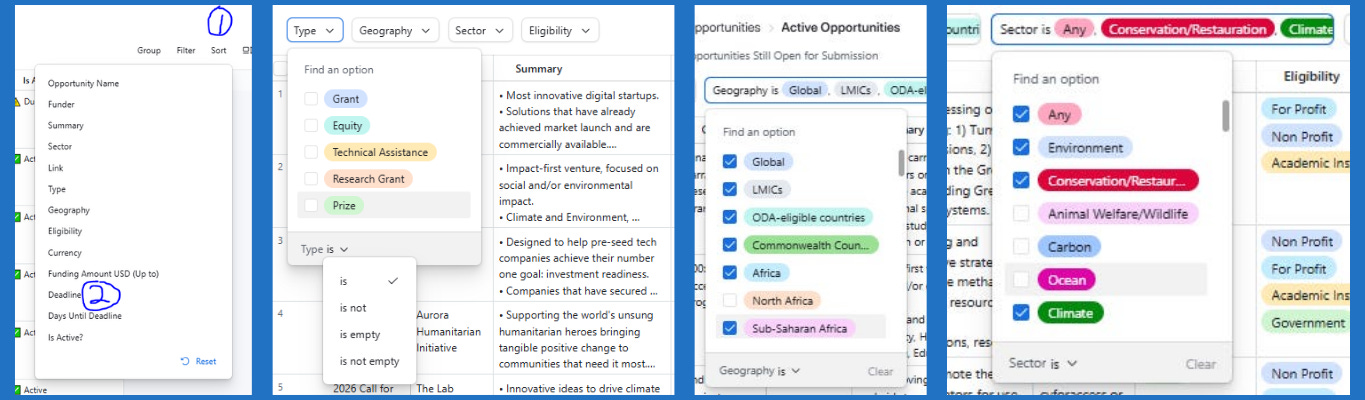
Grants Searchable, sortable, and filterable by:
Deadline
Funding amount
Type of Funding
Geography
Sector
Eligibility
How to (quickly) assess your availability for any RFP or grant program
RFPs can be 70 pages long. There’s nothing worse than getting your CEO, CFO, Sustainability Officer, and Grant Writer all making moves on an application, spending 30 hours on a first draft; and then discovering that the grant is only for nonprofits or your business is otherwise not eligible.
Here are the 10 steps that we at Fundraising Dispatch use each and every day to make sure a new RFP is worth our and our entrepreneurs’ attention, saving us 90%+ of our time seeing if a grant is worth pursuing.
Do a Quick Scan of the Grant’s Focus and Funding Amount
Check the Applicant “Type” Requirements
Check Application Deadlines and Cycles
Verify Industry or Sector Limitations
Confirm Geographic Eligibility
Assess Company Size and Revenue Requirements
Look for Targeted Demographic or Ownership Requirements
Examine Project-Specific Requirements
Deep Dive into the Financial and Organizational Requirements
Double Check the FAQs
Hint: “CTRL + F” is going to be your best friend
See the full guide here:

Tips: Writing a winning application
When you’ve found a grant that you think your organization checks the boxes for…
Double check.
Then. It’s time to start writing.
Our full guide coming soon!
Tips: Catering your application to what the funder wants to hear
We dive into this with a case study, here:

In short:
Read between the lines
What problem is the funder trying to solve?
How does your proposed solution solve that problem? And how can it scale.
Look deeper into previous winners
What do they have in common?
Does the funder lean towards funding African nationals?
If 90% of previous winners are nonprofits and think tanks (although they say that for profit companies are eligible)… is it really worth your time to fill out the application?
Understand the funder’s priorities
Example: Gates Foundation
Probably the largest philanthropic funder in the world. They have/had grant programs in financial inclusion. They have/had grant programs in renewable energy. They have/had grant programs in agriculture.
But where does most of their funding focus? (80-85%).
Healthcare.
And from those healthcare grants, probably 80% of those have had a focus in maternal/new born care. So Gates cares about healthy moms and babies.
If your AgTech will apply for a Gates grant… you have to highlight how your work positively impacts moms and babies.
Fundraising Dispatch’s other fundraising resources
All designed to help make fundraising easier for mission driven organizations in Africa.
🌍 Weekly alerts on new social impact grants in Africa and beyond (here)
👨💻 A searchable and filterable database/calendar on these and rolling grants (here)
💸 Your best funder is a new customer: leveraging LeadGen & Outbound Sales to scale (here)
⏰ A Guide to Reviewing Grants and RFPs; key strategies to save 90% of your time spent seeing if your business is eligible for any grant (here)
🤝 The best Investment Conferences in Africa, how you can get in for free, and how to set up 20+ in person meetings (here)
👻 What to do when a funder ghosts you (here)
🔊 How to prepare for your pitch (here) and knock it out of the park (here)
With much more to come!
Summaries of the grants mentioned above (that you can apply for today!)
A curated sample of open opportunities for you. (With more here and here).
Under $100k
Awesome Foundation Micro Grants. Awesome Foundation.
• Awesome project on wide range of areas including arts, technology, community development, and more.
• Individuals, groups, and organizations working anywhere in the world.
• $1k.
• Applications accepted on a rolling basis.
Startupbootcamp Accelerator Program. Startupbootcamp.
• Intense 3-month accelerator program designed to drive the transition to regenerative agriculture and resilience of the food sector by fostering disruptive innovations on a global scale.
• Early-stage, pre-Series A venture. Proven technology with signs of market validation.
• All countries.
• €25k cash investment to cover program expenses plus an exclusive startup deal kit valued at over €100k, packed with premium partner offers.
• December 7, 2025.
2026 Startup Innovation Challenge. Energie AG Oberösterreich.
• Innovative ideas, newest technology and creative approaches to help push the energy industry to the next level.
• Topics: 1) Digital Customer Service World, 2) Renewables SiteFinder; Boosting Wind and PV transition with AI Solutions and 3) AI Enabled Energy Audit and Consulting for SMEs.
• Well-established startups or companies with a minimum team size of three employees that have moved beyond the initial ideation phase.
• All countries.
• Up to €50k funding.
• January 4, 2026.
Climate Intervention Environmental Impact Fund Grant. Climate Intervention Environmental Impact Fund (CIEIF).
• Supports: 1) EIA (environmental impact assessments), 2) predictive impact modeling, and 3) engagement efforts with potentially impacted stakeholders; for innovative climate intervention technologies that are on the verge of field testing.
• All countries.
• $75k grant.
• March 15, 2026.
Over $100k
Developpp from GIZ & BMZ (Germany). Have quarterly calls for proposals for the two opportunities below.
Ideas Ventures for Start-Ups. € 100K (plus potential for top-up funding). Registered and active in Ghana, Kenya, Nigeria, Rwanda, South Africa, or Tanzania OR plan to register before the start of funding. The company is innovative, impact is measurable and contributes to reaching the SDGs by increasing local income, saving natural resources, improving access to resources and services, and creating decent jobs.
Takes place twice a year (Due June 30th and December 30th).
At least 1 annual financial statement.
Viable business plan and a financial plan;
The company should not have acquired more than a maximum of EUR 2 million in funding to date.
The company must receive matching funds equaling the amount of the grant financing in the form of cash injection from other investors.
Matching funds can be considered if received up to 6 months prior to the application and still available for the develoPPP Ventures investment. T
Classic Ventures for Companies. Up to €2m. 50% Co-financing required. Due 30th of (due March 30 and October 30); Over 60 developing and emerging countries around the globe (see: develoPPP Classic country list).
Supported projects can be located in very different sectors and thematic areas:
the training of local experts
piloting of innovative technologies and demonstration plants
sustainable expansion of supply chains
improvement of environmental and social standards.
What all develoPPP Classic projects have in common is that they combine a long-term business interest with a sustainable developmental benefit.
have at least eight employees
have an annual turnover of at least 800,000 euros
have at least two audited annual financial statements
have a positive net income as well as sufficient equity capital and liquidity to ensure your company’s contribution
Livelihood Impact Fund.
• Target interventions with the potential to have 5x increase in participants’ earnings for every dollar spent in 5 years.
• Agriculture: smallholder farmers productivity and regenerative agriculture; Entrepreneurship: micro, small & medium enterprise development, business growth programs; Workforce Development: employability training programs across industries.
• Invest in African-led organizations with budgets between $150k and $1m.
• Provide three-years of unrestricted funding combined with capacity building support to help organizations move to the next stage of their growth.
• Grant sizes range from $100k to $250k per year depending on annual budget sizes (usually no more than 30% of annual budget).
• Rolling applications.
DRK Foundation Grant Program. Draper Richards Kaplan Foundation.
• Early-stage social impact organizations (post-pilot and pre-scale) solving the world’s biggest social and environmental problems using bold, scalable approaches.
• Independent nonprofit or mission-driven for-profit entities.
• Africa, Europe, India, and the United States. Latin America and Israel will be considered in select situations.
• Up to $300k in either unrestricted grant funding or investment capital over a three-year period.
• Applications accepted on a rolling basis.
UNICEF Venture Fund: Call for Open Source Frontier Tech Solutions. UNICEF.
• Open Source frontier technology solutions that have the potential to create radical change for vulnerable children.
• Early-stage, for-profit technology start-ups.
• Women-led and women-founded startups are encouraged to apply as well as Youth-led startups (individuals younger than 35 years old).
• UNICEF’s programme countries.
• Up to $100k in equity-free funding.
• November 30, 2025.
Seeding The Future Global Food System Challenge. Welt Hunger Hilfe (WHH).
• Innovations leading to: 1) safe and nutritious food for a healthy diet, 2) sustainable or regenerative practices that enable food systems to stay within planetary boundaries, including food waste and food loss reduction and 3) equitable access to food that is affordable, appealing and trusted.
• Scientists, engineers, innovators, entrepreneurs, and multidisciplinary teams from NGOs, non-profits, social enterprises, universities, research institutions and small/emerging for-profit enterprises.
• For profit entities should be pre-Series A with financial assets not exceeding $10m
• All countries except those against which the U.S and/or Germany maintains comprehensive sanctions.
• Up to $250k grants.
• December 15, 2025.
Matching Grants Under the COMESA EAC Horticulture Accelerator (CEHA). Common Market for Eastern and Southern Africa (COMESA).
• Innovative agribusiness projects that enhance smallholder farmer incomes, promote gender equity, foster climate-smart practices, and strengthen competitiveness within horticultural value chains across the region.
• Operate within the potato, onion, or avocado value chain, including production, processing, aggregation, or export.
• For-profits.
• Kenya, Uganda, Tanzania, Ethiopia, or Rwanda.
• Up to $100k grant.
• January 14, 2026.
And so many more via links below:
Weekly Newsletters: https://www.fundraisingdispatch.com/s/grant-newsletter


Are you ready to pursue grants?
Stay tuned for more on Lendable’s partnership with Fundraising Dispatch (Georgina and your other program managers will share more soon!)
Fundraising Dispatch (this platform): Subscribe for new grants, access our database, and get exclusive access to other powerful resources like this Grants 101 guide
Grant & Co (our partners supporting fundraising directly): Learn more and get in touch with Daniel@thegrant.co if you’d like to chat more about supporting your grant writing (or connecting with relevant investors)