

Unfortunately, there are bad actors out there preying on founders, directors, and fundraising teams.
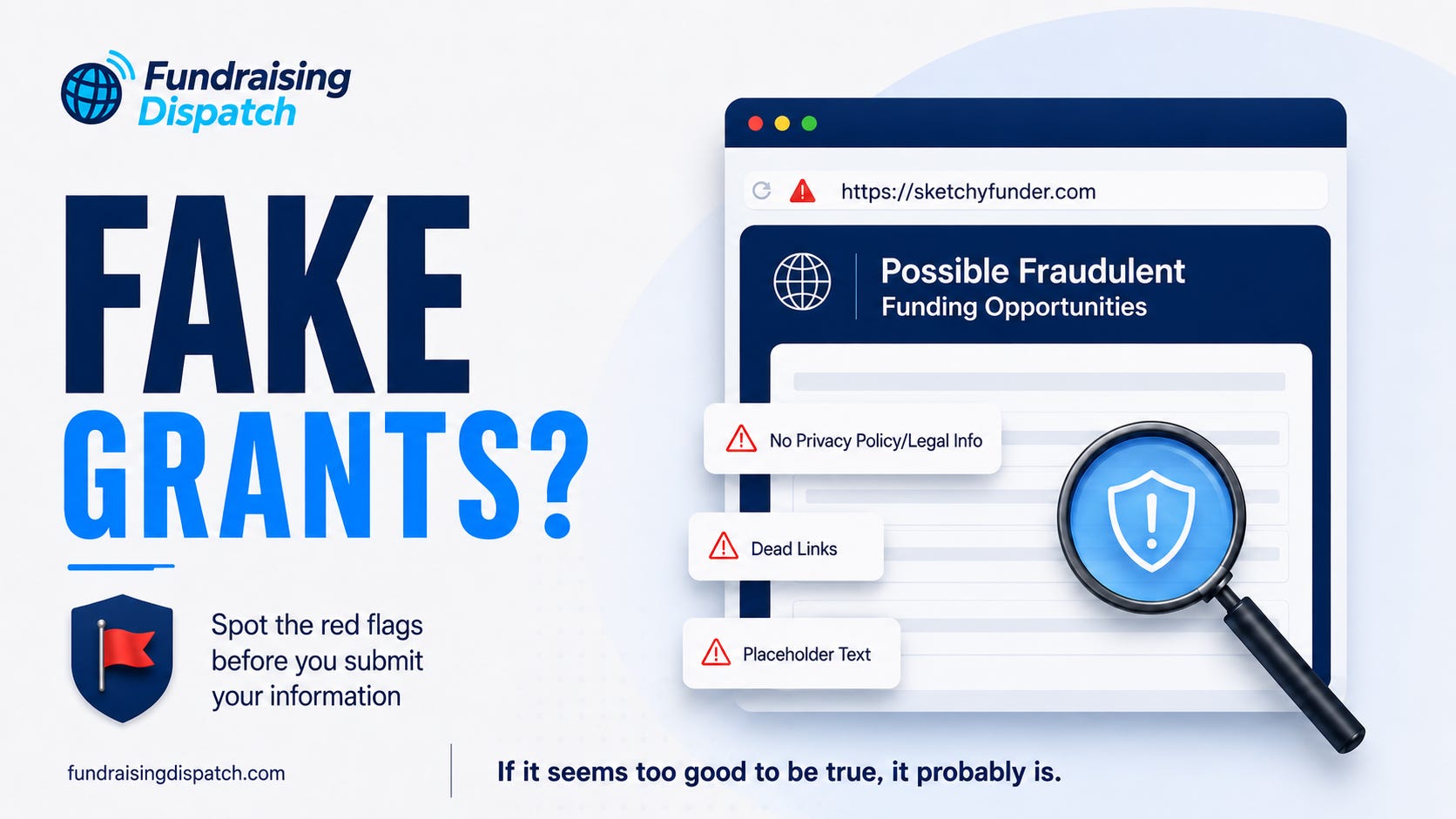
We (and many others in and outside of our network) recently came across some high ticket grant opportunities listed on a website and organization claiming to represent IFC, the International Finance Corporation directly.
That website has pages for 8 grant programs ranging from $75,000 to $10,000,000.
Women-Led Business Grant for up to $750k due August 20, 2026
Education Innovation Grant for up to $1m due August 30, 2026
Digital Inclusion Fund for up to $3m due September 15, 2026
Climate Resilience Fund 2026 for up to $5m due September 30, 2026
Agritech Modernization Grant for up to $2.5m due October 10, 2026
SME Growth Accelerator for up to $1.5m due November 15, 2026
Healthcare Access Initiative for up to $4m due December 1, 2026
Infrastructure Development Grant for up to $10m due December 15, 2026
Sadly, these listings, application submission forms and the website they are hosted on overwhelmingly point to being fraudulent, misrepresenting themselves as the IFC and providing access to World Bank funded opportunities.
What’s worse, we’ve seen countless funding databases, media outlets, entrepreneur support organizations, investors, and “influencers” on LinkedIn (and/or their AI Agents) pick these up and distribute them and the ifcgrants[dot]org website to their networks
Without doing the needed due diligence.
Blindly assuming what they saw online was real and valid.
Using these listings to help their social media posts get clicks and engagement and themselves get a “follow”, “subscription,” or to otherwise build their network.
And we could have easily been one of them.
But something felt funny. These grant opportunities seemed a little too good to be true. And we flagged them as part of our effort to ensure we only share active, verified funding on our platform.
🕵️♀️ So we got to work.
The below details our red flags on ifcgrants[dot]org and can help you think about things you should double check before submitting information on yourself or your organization to an (apparent) funder.
Quick note:
We reached out to some IFC contacts for comment and to confirm/deny the legitimacy of the site. It was familiar to none. No one (ourselves included) could find IFC.org pages or information pointing to this site, affiliation with it, or mention of the application forms as official IFC programs.
While we’re still investigating… we hope our worst fears aren’t realized and whoever is behind the website and collecting “applicant” data is not using it for serious scams.
And although the application forms on this website don’t ask for extensive details (or financial information), if they are fraudulent, scammers may be collecting enough information to impersonate your organization, target your finance team, apply for services in your name, or run a more convincing scam, later.
If you’ve already “applied” to any of these “grants”, exercise caution if you’re contacted directly (and please let us know if you have been).
Never provide any kind of access to your bank account
Watch for links to log in and/or enter your bank information
Consider carefully what should be discussed over email versus something less formal like WhatsApp or Telegram
Take note of any communication asking for urgency (technically the applications are due in August or beyond, right?)
Be careful clicking links in general
Think twice before sharing sensitive documents (unless you have a way to verify)
You may want to change passwords if you created an account or reused credentials
Be careful trusting a funder that requires an application fee (processing fee, registration fee, finder’s fee, etc) or any other payment before releasing funds.
And if you’re looking for new fully verified, active, funding opportunities in your inbox each week and online anytime… you know where to find them.
Hey, we could be wrong…
(Please tell us if you’ve heard otherwise or have a colleague at IFC who can verify)
…But we noticed a few things right away that made us seriously question the validity of this website and these funding programs.
So we thought it would be useful to highlight it as a general example for red flags to look out for when applying for funding.
Here is our guide with what raised our alarms on “ifcgrants[dot]org”
And the things we recommend you check for before applying to any open program or submitting any information on yourself and your organization.
If it feels sketchy… it probably is.
If it looks way too easy (especially for high ticket sizes)… it probably is (for a reason).
If it looks too good to be true… it probably is.
The thing we noticed first
ifcgrants[dot]org is not IFC.org
Well… duh… but hear us out.
The logo is the same.
The color scheme is similar.
The branding, in general, aligns.
It looks like a standard website. It’s not a terrible interface. Some might even say “less is more.” And legitimate organizations do sometimes use separate domains, campaign microsites, third-party portals, subdomains, or application platforms for affiliated programs.
But things seem off with a deeper look…
The FAQ - Frequently Asked Questions - page on the lookalike website is blank
Other pages are bare compared to IFC.org’s busy link and article-heavy pages
Especially the “About” page
There are dead links and redirects to the home page all over ifcgrants[dot]org
But most importantly… we could not find IFC’s main website mentioning or linking to ifcgrants[dot]org anywhere
And vice versa - there are no links here to the main IFC.org website
More on those two points below
There are some other obvious discrepancies in the footer of both websites.
Look at IFC official’s footer of (every page of) their website.

Now look at the lookalike footer.
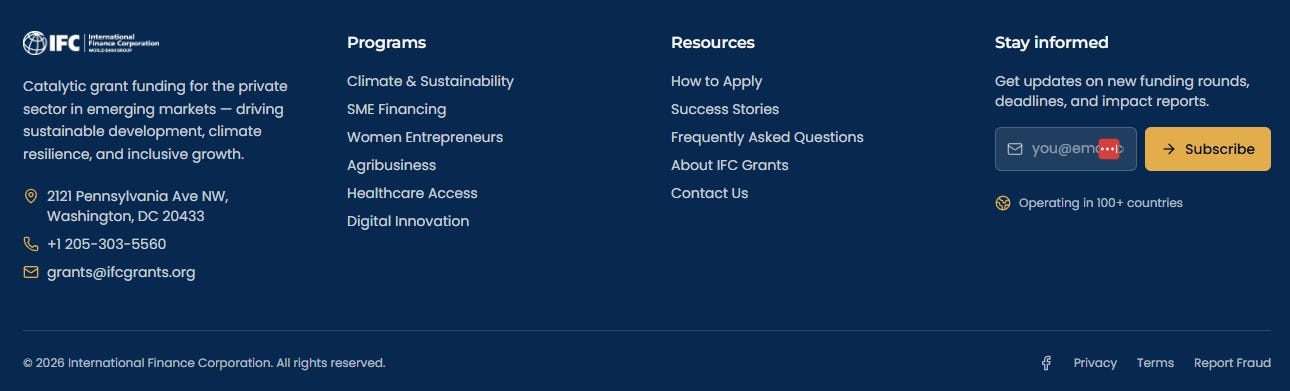
If IFC.org links to all of their social media pages - why wouldn’t a page of theirs promoting and accepting applications for millions of dollars of their grants?
Why would their official copyright in the sign off be different?
Why list address, email, and phone number on one website but not another?
IFC has their website localized and translated into many languages - but their “grant portal” is just in English?
🚩 The biggest red flag 🚩
There is no “Privacy” Policy. The link to it is dead/goes nowhere.
(The “Report Fraud” and “Terms” pages lead to dead links too.)
You think IFC, a major DFI and implementing arm of the World Bank would have official websites, pages, and programs (especially those collecting user data) without meeting full legal compliance?
Crossing every “t” and dotting every “i”?
In many jurisdictions, collecting personal information through a website creates legal obligations to clearly disclose who is collecting the data, why it is being collected, how it will be used, whether it may be shared or transferred, and what rights the individual disclosing the data has. GDPR, UK GDPR, California’s CCPA, and South Africa’s POPIA all contain versions of this transparency / notice-at-collection requirement.
IFC.org’s own privacy page is a 20-page pdf document.
Seems strange that the website promoting their multi-million grant programs’ privacy disclosures would lead to a dead link, doesn’t it?
There’s also no opt-in (check box) when submitting your “application”.
Wouldn’t you need to tell IFC you agree to receive communications from them on the results of your application?
And speaking of the application process…
The submission forms are quite short and straightforward.
Too short and straightforward if you ask us.
One submission form for 8 different multi-million-dollar grant programs?
And they all have different funding amounts and deadlines?
Is an organization as big and as formal/regulation-bound as IFC going to simplify things that much? We don’t think so.
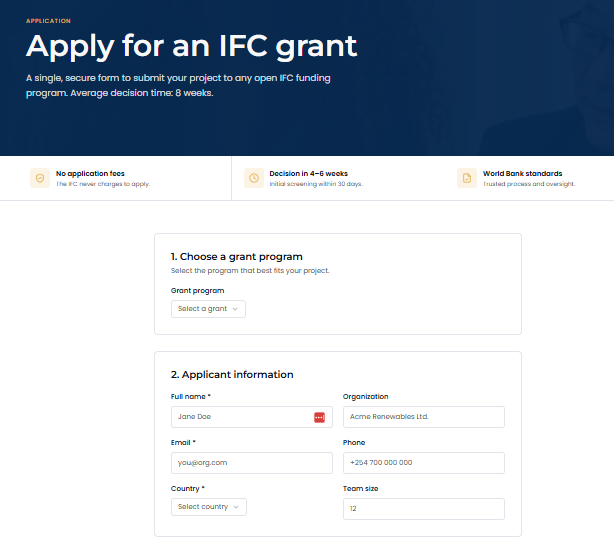
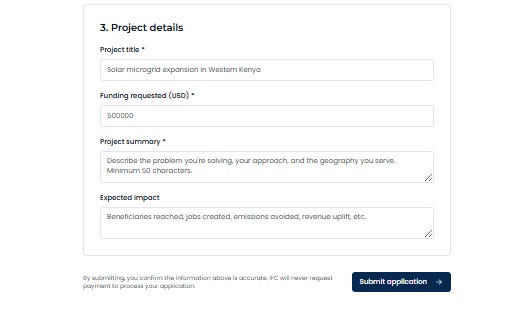
Just “Name, Email, Country, Project title, Amount Requested, and Project Summary” as required responses?
That’s all that IFC is going to ask in an application for $5,000,000 and in an 8 week time frame to have their decision?
Even if this is just for an initial screening …
From a funder that mobilized & committed $71.7 BILLION in capital last year? (https://www.ifc.org/en/insights-reports/annual-report)
If it seems too good to be true, it probably is.
Here’s the truth from:
https://www.ifc.org/en/what-we-do/products-and-services/how-to-apply-for-financing
“There is no standard application form for IFC financing. A company or entrepreneur, foreign or domestic, seeking to establish a new venture or expand an existing enterprise can approach IFC directly.
Proposals can be submitted to IFC’s industry departments; regional departments at IFC headquarters in Washington; or the regional field office closest to the location of the proposed project. To determine which contact is most appropriate for your organization, please see IFC Contact Directory.”
Looks like ifcgrants[dot]org directly contradicts this.
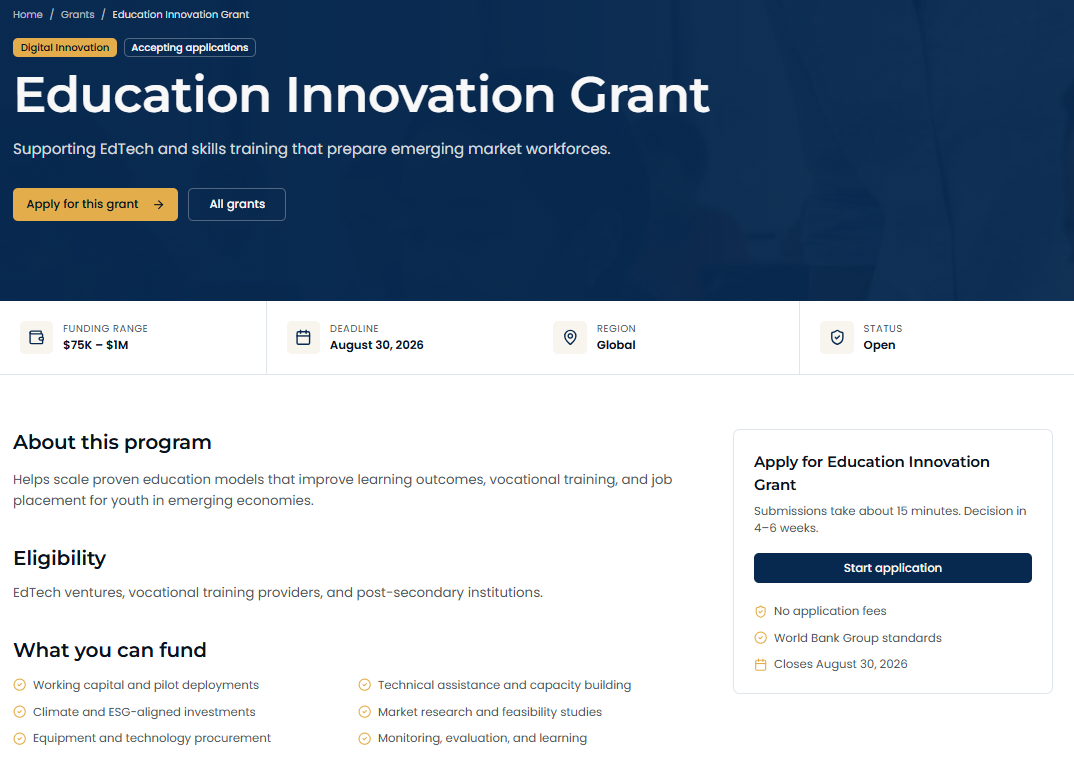
And let’s talk about the pages/listings for the grants themselves
Here is one of them:
And another:
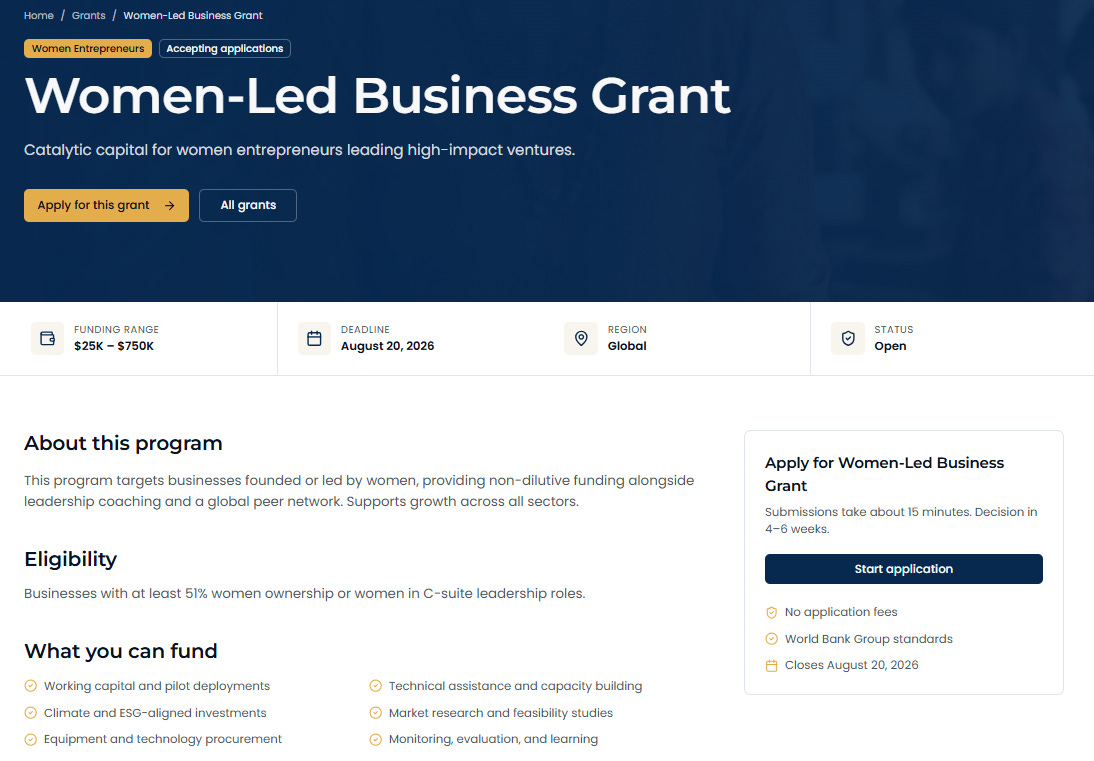
Credible grant listings and Calls for Proposals usually have entire sections/links that
Summarize the program
Clearly define eligibility, geography, sector etc
List benefits to winners
Outline specific criteria
Explain what the funding can and cannot be used for
Give insight on the review / selection process
Provide FAQs
ETC
And most importantly, more often than not, include:
A downloadable full RFP and guide for applicants
Especially grant programs at large funders. And well publicized ones too.
Definitely at a $71.7 billion a year DFI.
Just compare against any of the 200+ active grant programs we feature on our weekly newsletters. And click below so you can stay informed on legitimate new programs and access valuable guides like this one.
Other Red Flags
The emails listed on the sites are at different domains.
At first glance, we didn’t think it would make sense that IFC representatives would engage in official communication outside of their main domain (ifc.org).
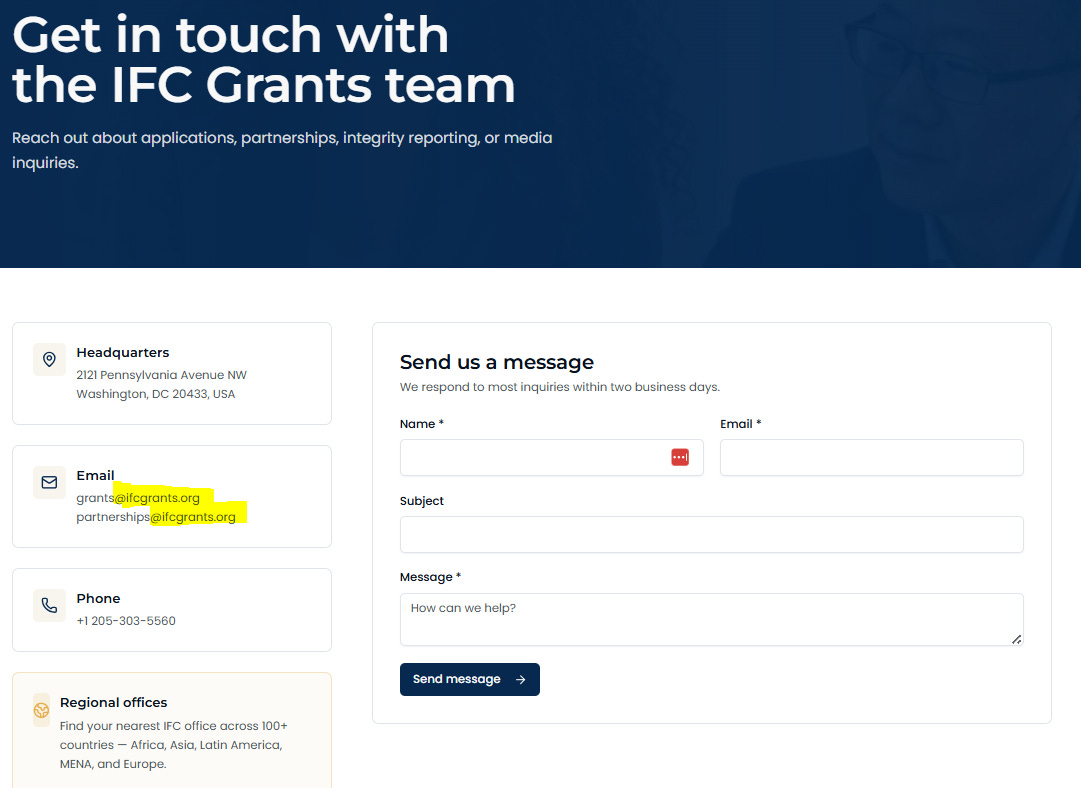
And IFC.org confirms it in their own “Scam Warning” page - linked in their footer.
“Official communication from IFC will always come from emails ending in "@ifc.org”.”
Phone numbers are at different prefixes:
Every other IFC United States contact phone number is a +1 205 XXX XXXX format.
Why would an affiliate grant making arm have a different one?
Ok. Ok. So phone numbers aren’t often standardized, but,
We called IFC and the operator confirmed all people that work at their US office have 205 prefixes in their work phone numbers.
Just three success stories? With a repeated image? And the links aren’t clickable?
With the amount of links to different projects, reports, and otherwise all over IFC.org - its a little surprising that an affiliated page of theirs would be so bare.
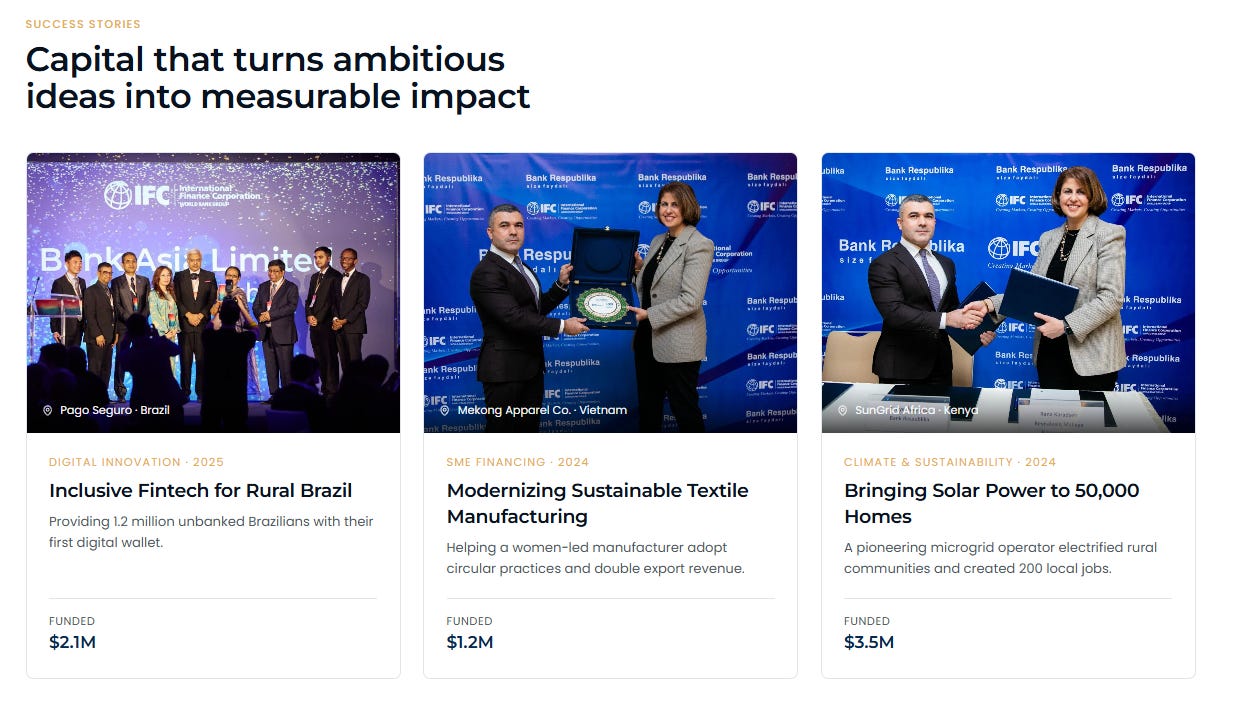
Pretty obvious placeholder text
We already had our doubts, but this is the one that put us over the fence
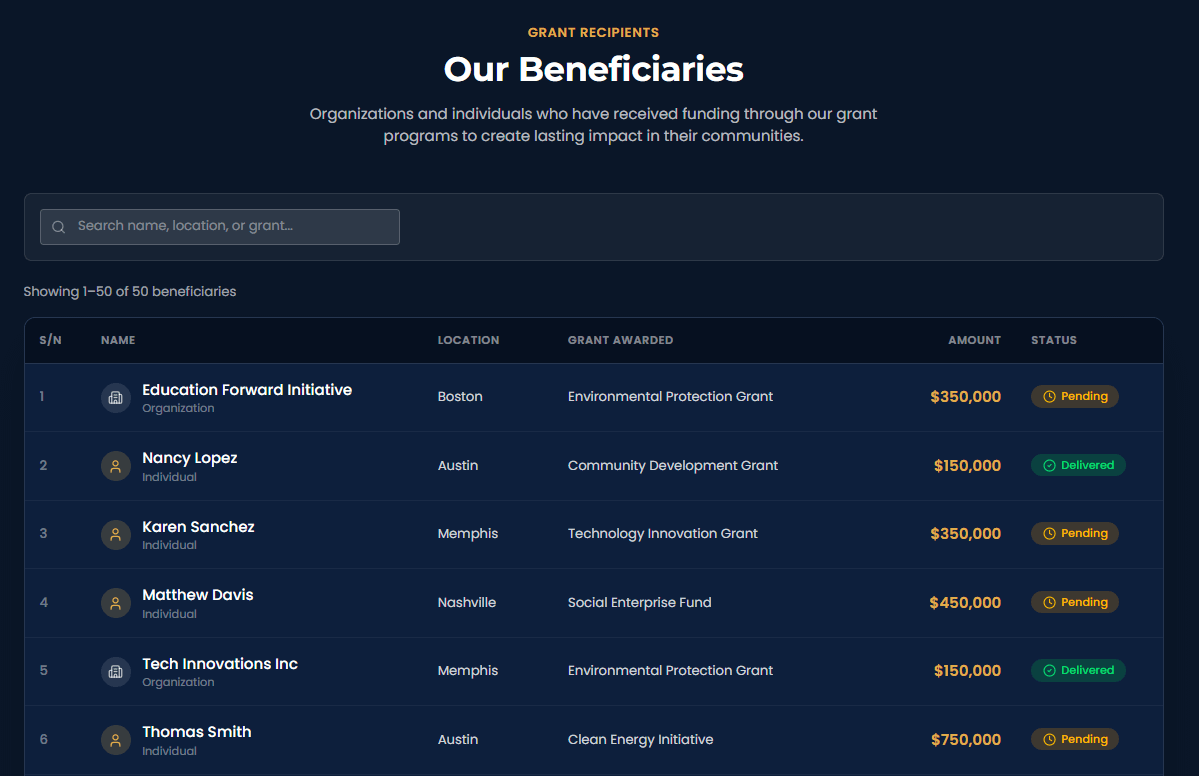
IFC has a pending grant award with “Karen Sanchez” and a delivered grant to “Tech Innovations Inc” in Memphis, Tennessee in the US?
🚩🚩 Sure they do. 🚩🚩
This beneficiary listing has changed a few times over the last few days.
There were delivered grants to a “John Smith” in Los Angeles on the page a few days ago.
Oh yeah, and IFC does also say that they:
“Do not lend directly to micro, small, and medium enterprises or individual entrepreneurs, but many of our investment clients are financial intermediaries that on-lend to smaller businesses.”
https://www.ifc.org/en/what-we-do/products-and-services/how-to-apply-for-financing
If it looks sketchy, it probably is.
Alright, so we’ll keep monitoring
We’ve gone back and forth here - especially given how widely publicized these grant listings have been and the fact that the submission forms on the website don’t really ask for any information that’s too sensitive (at this stage).
But, ultimately…
Maybe one or two things can slide; A “bad” website/application process does not automatically mean a fake funder (we’ve seen a lot of clunky portals, broken links, missing privacy pages, outdated PDFs, confusing instructions, ugly forms, etc).
But we think all of the red flags above, combined together, are too big and too red not to at least notify our network to exercise caution with these supposed grant opportunities.
And we’ll certainly eat our words if these programs turn out to be legitimate applications for funding.
(Feel free to apply/submit if you think it’s worth the risk. But we won’t be.)
Who knows. Maybe IFC is trying something new or a department was asked to vibe code a new website.
But given all of the above and the direct contradictions on IFC.org… We really don’t think so.
- Have some information we may have missed?
- Do you work at IFC, or know someone at IFC, who can communicate that these programs are actually legitimate?
- Have you received a communication from someone at ifcgrants[dot]org after submitting your information?
Reply to this email or send us a note at info@fundraisingdispatch.com.
What can you learn from this example?
We recommend you follow these steps when you assess a website offering funding.
One red flag wouldn’t always be cause for alarm, but when several show up together, take a deeper look before assuming it’s all valid.
Check the domain, could it be a fake or lookalike?
Check for a copyright at the bottom.
Check for a link to a privacy policy or other legal pages.
Are there dead links / blank pages?
Is there a clear way to contact the organization?
Do the contact emails match the domain?
Check character by character (there were known scams, for example, with individuals using the email domain “un-ops.com” to misrepresent themselves as people working at “unops.com”)
Phone numbers will vary so no need to check those (it was just an interesting detail about IFC specifically)
Do they list staff members? Can you verify people elsewhere?
Are they asking for fees, bank details, passwords, IDs, or sensitive documents super early in the process?
Is there a named contact, helpdesk, webinar, Q&A process, or applicant support channel?
And if/when you’re assessing a funding application or form on a (separate) website:
Does that funder mention that program anywhere else on their main website or in a press release?
Does the official funder website link to the application listing/page?
Does the application process match other processes from that funder?
How much information is given? Does it look specific, complete, and verifiable or generic/placeholder?
Is there a link to a full RFP/application document?
Does it feel too good to be true? Does formality match how much money is being offered?
Basically, you ask yourself these questions
Does the page/opportunity pass the formality test?
Does the page/opportunity pass the compliance test?
Does the page/opportunity pass the realism test?
If you’re ever in doubt, try to email a verified (listed) contact email from an official site (not on a questionable page) to confirm.
So maybe don’t get your hopes up that you’re magically going to get millions of dollars from IFC via a five question online form.
Spend your time applying elsewhere, like on one or more of our 200+ active funding opportunities.
Remember, the grant and investment programs you’ll find on FundraisingDispatch.com are ones that we manually (yes, manually, we don’t trust AI yet) assess and validate.
There are thousands and thousands of funders out there.
And there are databases that list them.
We could give you their names (in fact, we’re working on making more of our internal databases public facing) but unless you’re really good at cold outreach, getting referrals from your network, or plan to attend a lot of in-person ecosystem events… you’re really better off with just our databases of active and rolling RFPs (so you know the funders behind them are actually funding).
You can subscribe to premium to make sure you have eyes on all of these opportunities either via our weekly newsletters or database.

Here’s more from IFC and World Bank on potential fraudulent programs.
https://www.worldbank.org/en/about/legal/scams
https://www.worldbank.org/en/about/legal/scams-misrepresenting-wbg-name
Bottom line:
Be careful when you find a funding opportunity on the internet or when providing details about yourself and your organization.
And if you heard about these grant opportunities from a colleague or someone on social media - maybe they should take a quick read through this post as well.