
FundraisingDispatch.com. Your weekly one-stop-shop for grant opportunities, calls for proposals, requests for applications, and other programs published by funders like GIZ, Gates Foundation, AECF, Norad, and many more.
Grants and investment opportunities under $50k -> free.
Grants and investment opportunities from $50k to $10m+ -> premium.
Special Edition: €50k - €250k Grant for Sustainable Agricultural Supply Chains due June 15th
Many founders from our network have asked us about this new GIZ supported program. So we thought to highlight and dissect the latest call for proposals from SASI’s Due Diligence Fund.
TLDR Version
Due Diligence Fund (DDF) Funding Round 5. Sustainable Agricultural Supply Chains Initiative (SASI).
• Promising and innovative approaches to human rights and environmental due diligence (HREDD) in global agricultural supply chains.
• Particularly encouragement of projects with a focus on gender equity and social inclusion, celebrating the International Year of the Women Farmer.
• Commercial partners: connected to an agricultural supply chain through production, processing, distribution or enabling services.
• Commercial partners based in the EU, the EEA, Switzerland or the UK together with commercial partners based in an OECD-DAC-listed country.
• Up to €250k grant funding.
• June 15, 2026.
Want to learn more?
Keep reading.
*Quick notes on the below; If its our take/analysis we’ll have it in italics; otherwise its straight from the program’s website and call documents. If you plan to apply, you should do your own in-depth analysis and use the below as a general guide/reference.
What is the program?
SASI’s Due Diligence Fund, currently accepting proposals for its 5th funding round, is powered and commissioned by Germany’s Federal Ministry for Economic Cooperation and Development (BMZ). The program’s goal is to support innovative approaches to strengthening human rights and environmental due diligence (HREDD) in global agricultural supply chains.
“Projects focus on primary production in supply chains and address risks affecting people and the environment directly on the ground. Cover key due diligence topics such as deforestation-free supply chain, climate and biodiversity, digital participation, gender equity and social inclusion, as well as living income and living wages. Potentially affected people and groups (“rightsholders”), such as smallholder farmers and plantation workers, are actively involved in project design and implementation and benefit from the measures introduced." - https://www.sustainable-supply-chains.org/funds-projects/due-diligence-fund/
Human rights and environmental due diligence?
Efforts an organization undergoes to identify, assess, prevent, mitigate, and address real and potential negative impacts from their operations, supply chains and business relationships linked to its work.
So what is SASI looking to fund? And how can you position yourself to win?
We dug deep into the call documents, previous winners, FAQs, and reports published on previous learnings to figure it out.
Programs to “strengthen human rights and environmental due diligence in global supply chains”
Examples:
Ethical living income for farmers
Prevention of child labour and forced labour
No discrimination on the basis of gender, ethnic origin or other status
Decent and safe working conditions and practices
Mitigating deforestation, biodiversity loss, pollution, pesticide exposure and other environmental impact
Tracking and compliance in supply chains; transparency in sourcing; responsible purchasing
Provision of grievance and complaint mechanisms
Training and other support services
Projects intended to help answer questions like:
Are there child labour risks in this supply chain?
Are workers or farmers exposed to unsafe conditions?
Are women being excluded from income, leadership, land, or decision-making?
Are farmers earning enough to sustain their households?
Is the product linked to deforestation or environmental harm?
Can the buyer actually trace where the product came from?
Is there a trusted way for farmers or workers to report problems?
Are European buyers changing their own purchasing behavior, or just pushing compliance costs onto producers?
Who can apply?
Partnerships consisting of
One or more commercial partners based in the EU, the European Economic Area (EEA), Switzerland or the United Kingdom (UK)*
And at least one of the following:
one or more commercial partners based in a OECD-DAC-listed country
one or more public-interest organizations with relevant expertise
*A company registered outside the EU, EEA, Switzerland, or the UK can be eligible if it has a registered office within these regions and the relevant commodity is exported into the EU.
Specific Eligibility Requirements: Companies
The Commercial Partner(s) (EU+) must have at least eight employees and an annual turnover of at least EUR 800,000. To prove this, at least two annual financial statements of each Commercial Partner (EU+) must be submitted. If the partner cannot provide financial statements, it may submit balance sheets instead.
Eligible companies are those:
i. whose operations, products or services are connected to an agricultural supply chain (upstream or downstream), including through production, processing, distribution or enabling services, and
ii. that can cause, contribute to, or be directly linked to actual or potential adverse human rights or environmental impacts, and
iii. that have leverage or can reasonably seek to build leverage (including through collaboration), to prevent or mitigate those impacts.
iv. Entities providing only advisory or standalone technical services without such influence are excluded as Commercial Partners but may participate as “Supporting Entities”.
*Supporting entities may provide part or all of the required co-funding, provided they are a foundation or an organisation of which the Commercial Partner (EU+) is a member.
What this means in plain(er) English (i.e. our take):
Option 1: EU Company at €800k or more in annual revenue (bonus if you’re based in Germany)* + OECD-DAC Country Company + Nonprofit, think tank, advocacy group, farmers cooperative, consultancy, ESO, etc
Option 2: EU Company at €800k or more in annual revenue (bonus if you’re based in Germany)* + OECD-DAC Country Company
Option 3: EU Company at €800k or more in annual revenue (bonus if you’re based in Germany)* + Nonprofit, think tank, advocacy group, farmers cooperative consultancy, ESO, etc
Not Swiss Company + Consultancy only. Not Kenyan Company only. Not German Company only. Not nonprofit only.
*You’re technically eligible if you’re not registered in the EU but you have an office there. Likely not going to funded though. If you plan to apply - someone in the consortium needs an active presence (physical and legal) in Europe.
And another key point from the call documents and terms and conditions.
“Commercial Partners (EU+) may only receive funds in exceptional cases. Germany-based commercial partners cannot receive funding.”
I.E. distribution of the grant funding will in a majority of situations only be made to the OECD DAC Country Consortium Member. Keep that in mind as you build out your project, budget, and dependencies.
Specific Eligibility Requirements: Projects
EU-relevance: Products produced in the selected supply chain(s) are traded in the EU Single Market.
On-site measures: The project provides for on-site measures in one or more of the OECD DAC-listed countries during the funding period.
Eligible activities: Funding will only be provided for activities that are primarily designed to prevent or mitigate previously identified risks or strengthen sectoral or regional due diligence systems.
What this means in plain(er) English (i.e. our take):
You have to work in Agriculture - in a supply chain with products that eventually make their way to Europe. You have to impact on the ground. You have to have done a risk assessment previously. You have to apply for a project designed to address/mitigate those risks.
European companies will work with their African counterparts to solve a supply chain problem and/or ensure more ethical and sustainable practices.
Screening test:
Strong fit:
Local suppliers, processors, cooperatives, or producer-linked businesses already selling into a European buyer relationship;
Public-interest organizations that can document field experience, rights-holder engagement, and implementation capacity in the project country;
OECD DAC subsidiaries or group entities that can show a qualifying EU+ office and genuine commercial leverage.
No fit:
Organizations whose commodity does not reach the EU market;
Consultancies, auditors, or software vendors with no direct work within the supply-chain
Single Applicants (no consortium)
Co-Financing Requirements
The Commercial Partner(s) (EU+) must match DDF funding with an own contribution based on the table below.
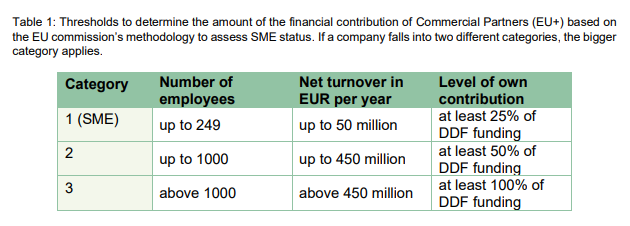
Contribution types: The own contribution can be provided through cash payments or in-kind services (e.g. provision of staff, real estate, etc.). In-kind contributions are only eligible if they are directly linked to the project’s activities, e.g. through participation in workshops, governance meetings or field trips.
What this means in plain(er) English (i.e. our take):
EU+ Companies: If you apply for €250K - you have to bring €62,500 to the table. It doesn’t have to be cash - but anything you “match” in-kind has to be specific to this project. It can’t be part of your standard work/programing.
More of Our Tips for Winning Applications & Projects
Let’s take some more key language from the call documents and translate that into SASI intended KPIs, must-haves in your proposals, ways to strengthen it and avoid certain pitfalls that could disqualify you.
We’ll also look closer at previous winners (consortium structures, intended initiatives, final results and deliverables, etc) and ways to get facetime with the SASI organizers to help increase your chances of winning.
Let’s start with this direct quote from the call documents:
“The most important point is that funding will only be provided for activities that are primarily designed to prevent or mitigate the risks identified in the risk assessment.”The risk assessment does not need to be a formal or externally commissioned study. It should clearly describe the identified environmental and/or human rights risks and specify the sources of this information. Typically, the assessment is carried out by the Commercial Partner (EU+) or by the Commercial Partner (Local) as part of their due diligence obligations. First-hand insights from field staff are welcome, provided you explain how the information was obtained and, where possible, supported or verified with external sources (e.g. NGO reports, studies, or other publicly available information). This information can be included directly in the proposal template. You can optionally attach your risk assessment but this is not required.
So that means:
