

Interested in finding grants to support your work and add to your impact?
You’re in the right place.
There are thousands of grants programs available for impact-focused organizations in Africa and in emerging markets around the world! Fundraising Dispatch curates opportunities and sends them direct to your inbox every week (here). We also provide guides and resources dedicated to growing your business, training your team, and making fundraising easier (here).
Its a new year and we’ve added a bunch of new subscribers.
So we thought it might help to take a step back and look at grants for social enterprises (for-profits) at a high level.
What even is a grant? Where do you start? How should you approach grant funding? And more.
Here’s what you’ll find here:
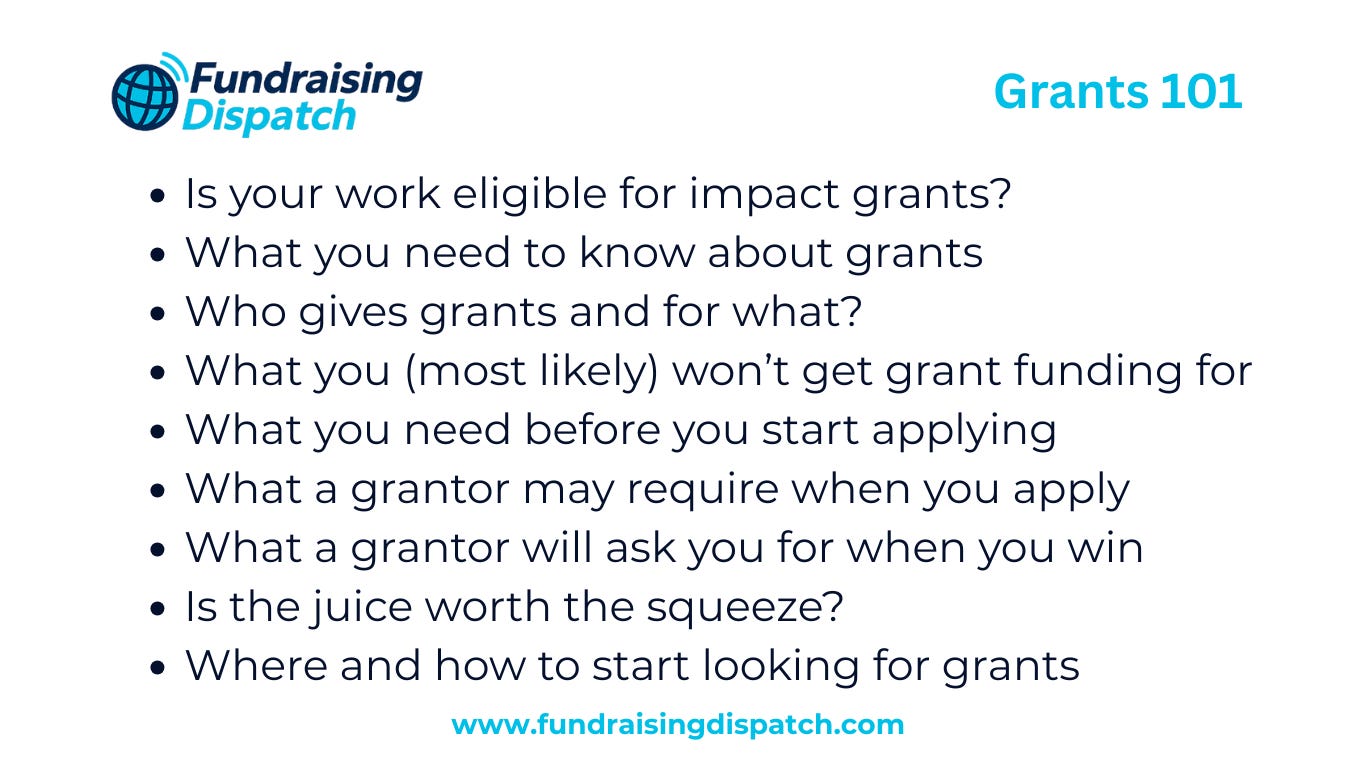
But first, let’s make sure you’re on the list to get new grants in your inbox every week and other powerful resources like this one.
Is your work even eligible for grants?
It starts with your business and your business model
90% of the time…
You have a legally registered entity in good standing and compliance
You do something that Western Governments/Donors consider to be a public good
Low income healthcare, micro/SME loans, humanitarian aid, renewable energy, job creation, environmental conservation, sustainable agriculture, food security, education, transition lab research to the field, ambulance/fire response, potable water, etc
Your leadership identifies as (and/or your work predominantly impacts) members of historically marginalized groups
The public good must be more cost-effective than “state-of-the-art”
And if you have an “innovation” (technical or not) or need funding for R&D or a pilot.... will your proposed work or innovation ultimately lead to a public benefit?
i.e. Social Impact
What you need to know about grants
Grant Funders don’t give money. They buy impact.
90% of the time grants are/have…
Non-dilutive capital
Specific alignment criteria
Project-based and restricted
Time-bound and mapped to specific activities, outputs, or outcomes
Some opportunities are very specific about what they will and wont fund
Tied to performance (often, contractually)
Not quick cash, free-money, or an instant lifeline
General rule of thumb is that you need at least a year of runway
Most grants require you to kick the project off with your own money and get paid back a reimbursement after you meet a milestone and report on your work.
And can often be in the form of TA - “technical assistance”
You don’t get cash, but you get things paid for (consultants, studies, etc)
A “good” time line you can expect
Writing the application
2-6 weeks
Reviewing, Double-Checking Documentation + Submitting
1-2 weeks
Hearing back from the grantor after submitting
3-6 months
Due Diligence
3-6 months
Legal/Signing
3-6 months
Cash in the bank
3-6 months
Can be longer depending on terms of first milestone, reimbursement, etc
At Grant & Co, where we support the grant process end-to-end for our clients, we are over the moon ecstatic if there’s cash in the bank 6 months after submitting. It usually takes a year. Often more.
See our list of 180+ funding programs actively accepting applications

Who gives grants?
Foundations (e.g. Gates, Skoll) —> To scale innovations that align with their mission
Corporate CSR Arms —> For branding, ecosystem stimulation, or inclusive supply chains
Local Philanthropies —> Supporting African-led innovation and entrepreneurship
Governments —> Supporting local/national targets
Government / Development Agencies (GIZ, Norad, AFD, Local, etc.) —> To drive job creation, economic development, trade and local innovation
Development Agencies/DFIs (Proparco, BII, DFC, etc) —> To achieve global impact SDG-aligned outcomes (e.g. health, climate, agriculture)
Development Banks (Afreximbank, EIB) —> To catalyze market development
Multilaterals (World Bank, UN) —> For market development and systems change
Intermediaries / Challenge Funds —> To de-risk early-stage innovation through competitions or pooled capital; with a specific sector/thematic focus
Family Offices & Individual Donors —> For passion and mission-alignment
What you (most likely) won’t get grant funding for
Quick cash needs (see above timeline)
General operating expenses, core commercial activities, or “Business as Usual“
You need grant funding because you have a project you want to carry out that will further social impact
Said project is not under your standard operational model because it would sacrifice profit
Additionality: Grantors will ask: “Does this company need our charitable dollars to do this project, or would it happen commercially anyway?”
Things that have residual value or easy to steal
Cars, construction (very easy to steal bags of cement, timber, etc), computers, land, large processing equipment
Overhead (Salaries), CapEx, Debt servicing, etc
One-Off Projects
Even R&D and Pilots have to link to the long term - systemic change
Is your business scalable? Is your work catalytic i.e. can your project be replicated in other settings?
You project needs to “have a life” beyond the grant
Anything related to gambling, tobacco, or alcohol
Complexity: the harder it is to tell your story, the harder it will be to get grant funding
If your business relies exclusively on grant funding (that’s why NGOs exist)
Your best funder will always be your customer
Are you pre-revenue, pre-evidence, pre-validation, and pre-operational?
Good luck :(
What you need before you start applying
Work, social impact mission, and general alignment with all of the above
A formally registered operational entity
Psst… Premium Subscribers… You’ll find our #1 cheat code for grant funding below 👇
(There are ways to structure your work & operations to help you get more grants)
Alignment with a grant program’s geography, registration, sector and other eligibility requirements
A specific grant-fundable project
Data Room
Standard investment readiness documents
Company Registration Information
Business Plan
Audited Financial Accounts
Budget & Financial Model
Pitch Deck
Some kind of social impact assessment (w/ baseline data and formal beneficiary tracking)
Advanced investment readiness documents
Feedback from customers, previous funders, etc
Capitalization Table, Shareholder agreement, Org Chart, Board of directors/advisors and LinkedIn/CV’s
Policy manuals
And many more
For premium subscribers, we have a list of 50+ documents that organizations should have when they fundraise; organized by priority (Must-Haves; Nice-to-Haves; Keep on your Radar).
The last thing you want (we’re speaking from experience) is to submit an application, not hear anything for 3 months, and get an email from the grantor saying:
We love the work you do and want to invite you to the second round of the funding application. You have 7 days to give us these 11 documents.
And 4 of them need to be notarized.
What a grantor may require when you apply (or win)
Matching funding
Cash (from the organization), In-Kind, or External Investment
Consortiums
NGOs, Academia, Governments, etc
Psst… Premium Subscribers… You’ll find our #1 cheat code for grant funding below 👇
(There are ways to structure your work & operations to help you get more grants)
Strict compliance
Vendors, proof of origin, invoicing, etc
Time-sheets, receipts, etc
Mile-stone based funding
Paid out in tranches
Third-party audits/evaluations
Public sharing of learnings
Or even the direct IP developed as a result of funding
What a grantor will ask you for when you win
Proof that the money will only be used for the approved purposes and that your organization checks all of the legal boxes
Sign a grant agreement/contract
Regular progress reports/calls
Often in their strict format
Financials/record keeping
They may even want a completely separate bank account for grant project activities
Proof of compliance(s) and lots of paperwork
Evidence of impact (M&E)
If you plan to pursue and leverage grant funding, you have to know that managing a grant can be a full time job in of itself
Founders should be focusing on day-to-day organic growth of their business
Not cumbersome reporting to make a funder happy
That’s why groups like Grant & Co exist

Want some support in writing your grant applications?
If you’re generating $100k+ in ARR and have the budget to treat grants like a marketing expense in your business (i.e. pre-payment + success fee)…
So is the juice worth the squeeze?
Grants aren’t a “crapshoot”. The wrong Grants for you are.
Just like advertising isn’t a “crapshoot”. The wrong advertising for your business is.
If you find yourself retrofitting your mission to meet the requirements of a grant... it’s likely not the right fit for you.
But Grants also aren’t free money.
Just like Sales at your company don’t come free either.
The truth is more subtle.
There are many dimensions of whether any grant is worth pursuing.
Does your company fit the RFP? Sector? Company Size? Registration Requirements?
Does your company fit with the funder? Does your company fit with the funder’s funder? Does your project fit the (often unwritten) goals of the funder?
What are the chances of winning? Is the prize worth the effort? Are there legal fees?
Once you win, will there be so much bureaucracy and reporting requirements that, at the end of the day, you wish you had never applied and accepted in the first place?
Making a decision on whether or not to apply for a grant is more art than science.
See our full article guide:

Fundraising Dispatch helps provide you the resources you need to make it worth it.
Where and how to start looking for grants
Leverage:
Your network
Local Governments, Organizations, Embassies
NGOs (both local & international) and Academia
Your visibility
FundraisingDispatch.com
(More on this next week in Grants 102!)
Rest assured that you’re in the right place!
Free Subscribers
Grants and investment opportunities from $0 - $50k direct to your inbox every week
Some public resources (like this one) for fundraising, B2B sales, building with AI
Premium subscribers
Grants and investment opportunities from $0 - $10m+ direct to your inbox every week
Access to our filterable/searchable database so you can always have a high-level overview of the grants available for you to apply to
End-to-end guides, walkthroughs, tips/tricks, cheat-codes, email/LinkedIn templates, messaging strategies, and more, to use alongside your fundraising. Not theory. Actionable recommendations. Step-by-step, plug-and-play, etc-etc-etc.
Live use cases for integrating AI and automation in your day-to-day
What’s coming next in Grants 102?
Types of Grant Funding
Where and how to start looking for grants
Two Paths: Reactive vs Proactive
And how they intertwine
Networking (and other) strategies to get on a grantor’s radar
Email and LinkedIn messaging templates for warm and cold outreach
Followed by full guides and end-to-end walkthroughs with our tips, tricks, and cheat codes for (quickly) assessing your eligibility for any RFP or grant program, catering your application to what a funder wants to hear, writing a winning grant application, and otherwise increasing your probability to secure grant funding.
What’s below for paid subscribers?
50+ documents we recommend you have in your arsenal when you fundraise and more insight into what you will likely need in your arsenal when you apply for a grant or enter due diligence with a grantor.
Our #1 secret (and recommendation) to getting access to grant funding.